
EduCheck at a glance
Making school problems visible, until they are fixed
EduCheck is the citizen monitoring service for schools of the Anti-Corruption Research Centre (CERC). Trained students, parents and teachers, organised in Integrity Clubs, monitor their school and school building sites with a common questionnaire.
Every problem found is published, sent to the school management and followed publicly until a fix is verified on site. Decision-makers finally have reliable information from the field.
- Verified findings, not rumours
- Public, downloadable data
- Protected monitors, never named
The challenge
Problems that decision-makers never see
In many schools, there is no channel of verified information between the classroom and those in charge. Difficulties take root because nobody sees or follows them.
Overcrowded classrooms
Rooms too small, leaking roofs, pupils sitting on the floor for lack of desks.
Water and latrines
Too few or non-separate latrines: a direct barrier to girls’ attendance.
Absent teachers
Lost teaching hours, with no simple way to report them.
Illegal fees
Fees charged to families without official basis, rarely challenged.
Poorly monitored building sites
Delayed works, poor-quality materials, bills of quantities never made public.
Excluded pupils
Buildings that pupils with disabilities cannot access.
How it works
From the finding to the verified solution
- 1
Train
CERC trains monitors in citizen monitoring, objective observation and data collection ethics.
- 2
Observe
During regular visits, always in pairs, they answer the common questionnaire and take photos.
- 3
Publish
Every « no » answer becomes a public problem, sent to the school management.
- 4
Dialogue
Students, management, parents and authorities look for a solution together, without accusing.
- 5
Verify
A fix only counts once a second monitor has confirmed it on site.
Who is EduCheck for?
The same information, three uses
Students and community
- Report a problem safely
- Follow every report until it is fixed
- Celebrate the repairs obtained
School heads
- Know the priorities voiced by students
- Answer and show the fixes made
- Highlight the school’s efforts to the authorities
Authorities and partners
- Target the schools and sites most in need
- Check the use of funding in the field
- Follow the correction rate over time
Our commitments
What makes EduCheck credible
Transparency
Problems, fixes and figures are public and free to download.
Protection
Monitors’ names are never published; only their role appears.
Dialogue
The aim is the solution, not sanction or blame.
Verification
A fix only counts once confirmed on site.
Inclusion
Girls and boys, pupils with disabilities: everyone has a place in the clubs.
Independence
Findings come from Integrity Clubs, with a method shared by all schools.
Concrete results
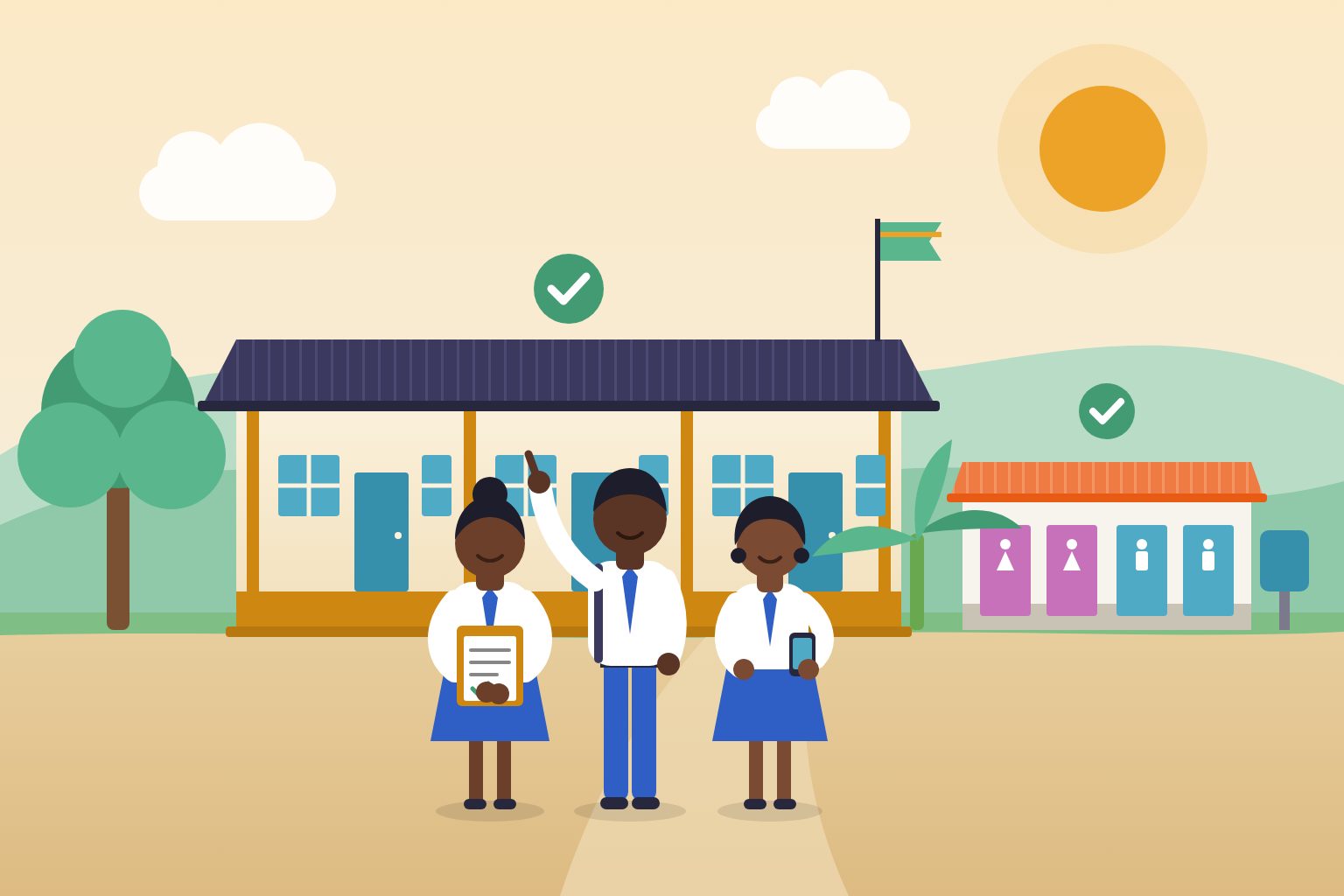 Success story · South KivuAt Institut Itara, three new classrooms and eight latrinesFifteen student monitors alerted the school: three toilets for 590 pupils and overcrowded classrooms. Their advocacy led to new buildings.Read the story
A proven method
EduCheck draws on Integrity Action’s DevCheck approach and on community integrity building, adapted to the Congolese context by CERC.
See the live figuresLooking ahead
Towards a national DRC network
By 2028, EduCheck S.A. aims for continuous citizen monitoring in more than 1,000 schools across all the provinces of the DRC.
- 2028Horizon
- 1,000+Schools monitored
- 26Provinces of the DRC
Two priority workstreams
- 1
Institutionalising the clubs
Anchor student monitor clubs in schools' internal charters, with the support of the Ministry of Primary, Secondary and Technical Education (EPST).
- 2
Data interoperability
Link EduCheck indicators to the national education management information systems (SIGE) to guide budget policy.
The 5 pillars of EduCheck
Five pillars, one loop
Each pillar prepares the next: trained students observe, data flows, dialogue leads to repairs, and on-site verification closes the loop.
Who does what?
- Student monitors observe their school every week and report problems.
- Teacher-Facilitators support the integrity clubs and the visits.
- CERC trains the monitors, checks and publishes every report.
- Schools and education authorities respond, repair and use the data to decide.
Context sensitivity
With the school management and the parents’ committee, CERC analyses the context and the actors of the school, obtains the agreements and records the starting situation.
Joint learning
CERC trains the student monitors and the Teacher-Facilitator. A joint working group brings together the club, the management and the parents’ committee.
Evidence base
Students visit their school with the monitoring form and record their findings on EduCheck, even offline. CERC checks every fact before publication.
Constructive engagement
Students present the facts to the management; the joint working group agrees a repair plan and advocates with the education authorities if needed.
Closing the loop
Students check the repair on site: the problem moves to “Resolved”. Successes are published and the impact is measured.
Then the cycle starts again: every verified repair restarts the monitoring.
- 01
Hands-on Training of Students
Student monitors are trained in the principles of citizen monitoring, objective observation, data-collection ethics and the use of the EduCheck mobile app.
- 02
Rigorous Field Monitoring
Every week, student monitors assess their own school themselves: the state of classrooms, the cleanliness of latrines, teacher attendance and the delivery of promised equipment.
- 03
Centralised Real-Time Data
Observations recorded offline are synchronised as soon as the network returns, feeding a dashboard open to head teachers and sector partners.
- 04
Constructive Dialogue & Joint Action
Community reviews are organised. Instead of blaming, students present tangible facts to head teachers to agree together on a repair plan.
- 05
Follow-up of Solutions (Fix Rate Certification)
The loop is closed when the repair is physically checked by the students. The problem then moves from "Identified" to "Resolved".
Act with EduCheck
Student, parent, teacher, school head or partner: everyone can help build better schools.